🌟A North Star for my PhD: LIFE and STAR
Over the past couple weeks, I’ve been navigating between various exciting paths I could work on during my PhD. Whilst free-form exploration is valuable, a great aid for staying on track whilst navigating is to choose a North Star. This post provides an argument for initially choosing LIFE and STAR as a North Star for my PhD.
For IUCN's STAR, here’s my argument for why it matters:
- We are facing urgent biodiversity and ecological crises.
- We want our actions to tackle these to be as leveraged as possible.
- The IUCN has global influence and authority on the state of nature and conservation. They advise the UN, governments, NGOs and large corporations. Their scope for impact is thus large.
- STAR is the IUCN’s flagship metric – they have recently publicly committed to it as their key tool for quantifying and directing nature-positive action.
- STAR will thus be increasingly relied upon by influential decision makers looking to achieve their biodiversity goals.
- To do so faithfully, and to preserve public trust, it’s important that STAR accurately reflects what it’s designed to measure.
For LIFE, see Dr Alyson Eyres's fantastic paper showing use cases for applying LIFE to inform conservation acton. One clear example is how it can help us understand how the biodiversity impacts of our dietary choices differ depending on the country we live in.
If you agree with those arguments, you can see why I care about LIFE and STAR, and why one could justify LIFE and STAR serving initially as an North Star for my PhD.
The next question follows: as a computer science PhD student, what are the best ways I can contribute to making these metrics better?
The conceptual diagram below is my attempt at capturing what I see as the biggest gaps and opportunities.
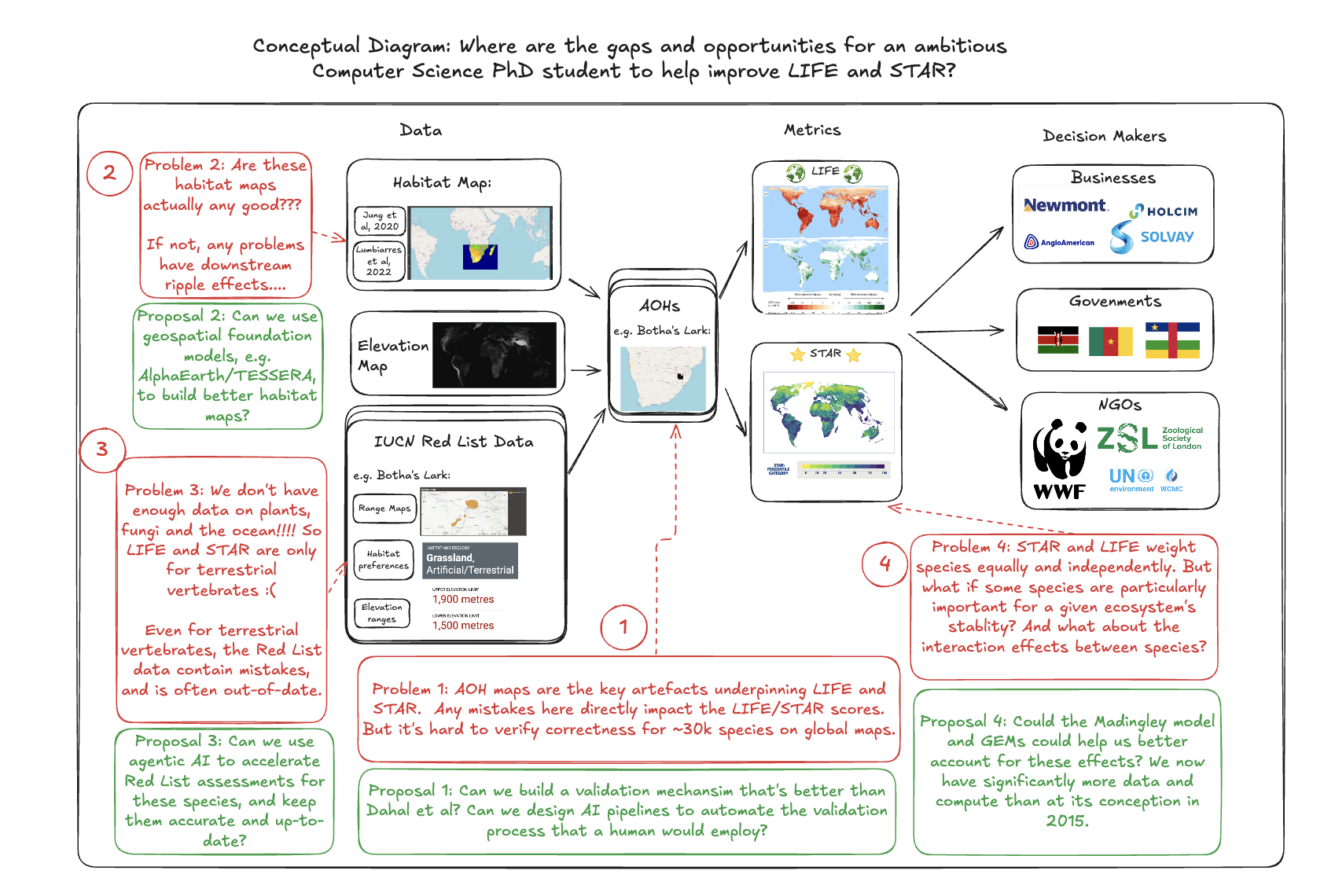
The opportunities can be summarised as:
- Improve the accuracy of the existing metrics (better habitat maps, more accurate and up-to-date Red List data)
- Extend their coverage to other taxa (plants, fungi, marine species), and
- Capture richer insights (include species interaction effects, simulations e.g. Madingley).
This lends itself to a series of research proposals to explore:
- Research Idea: Validating AOHs: Can we do better than Dahal et al?
- Research Idea: Towards better habitat maps using geospatial foundation models
- Research Idea: IUCN Red List – AI to Accelerate Red List Assessments
But where to start? It’s clear to see in the diagram that the AOH maps are the funnel – if the AOHs are wrong, LIFE and STAR are wrong. So, as Michael Dales argues, to be confident in LIFE and STAR being correct, we first need to validate the constituent AOHs are correct. The current validation standard was set by Dahal et al, but we think we can do better.
So, we’ll now move on to… Research Idea: Validating AOHs: Can we do better than Dahal et al?